
Knowledge base

Sierra Energy History: Building the Future of Waste Conversion
This is the Sierra Energy company logo, not a chart or data figure. It features a stylized flame or teardrop shape rendered in two colors—a dark slate gray/teal on the left portion and a bright cyan blue on the right—with the company name "SIERRA ENERGY" displayed in dark gray uppercase letters stacked below the graphic. The design conveys energy and fluidity, likely representing the company's focus in the energy sector.

Sierra Energy: Building the Future of Waste Conversion

Founded in 2004 in Davis, California, Sierra Energy was created around a simple but ambitious idea: that society's waste could become one of its most valuable resources. Rather than viewing municipal solid waste, biomass, and other discarded materials as liabilities destined for landfills, the company's founders envisioned a technology capable of transforming them into clean energy, renewable fuels, and reusable materials. That vision became FastOx® gasification, a proprietary process built upon proven blast furnace principles and adapted for the modern challenges of waste management, energy security, and decarbonization.

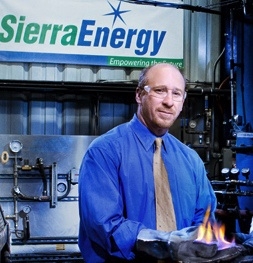
The origins of FastOx stretch back even further. The core concept grew from work by former Kaiser Steel engineers Bruce Claflin and John Jasbinsek, who recognized that blast furnace technology could do far more than produce steel—it could safely and efficiently convert waste into valuable synthesis gas. Sierra Energy acquired the rights to the technology and began the long process of transforming an industrial concept into a commercially viable platform. Under the leadership of founder Mike Hart, the company assembled a multidisciplinary team of engineers, scientists, and industry experts committed to solving one of the world's most persistent environmental problems.
This image is a corporate photograph rather than a chart or diagram. It shows a man wearing glasses and a blue button-up shirt standing in an industrial facility, holding what appears to be a piece of material with a visible flame. Behind him is industrial equipment with piping and gauges, and a large "SierraEnergy" logo with the tagline "Empowering the future" displayed on the wall.

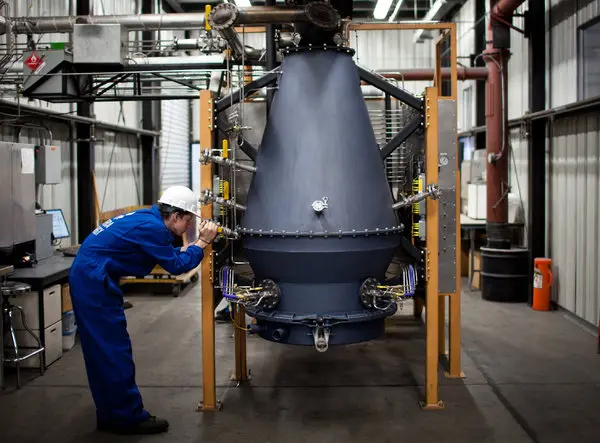
The early years were devoted almost entirely to research and development. Beginning in 2009, Sierra Energy partnered with the U.S. Department of Defense at the Renewable Energy Testing Center (RETC) in Sacramento, where successive generations of prototype gasifiers validated the underlying science and engineering. Through multiple design iterations, the company demonstrated that FastOx could process a wide variety of feedstocks—including municipal solid waste, biomass, tires, and other difficult materials—while producing high-quality synthesis gas and an environmentally stable vitrified stone rather than hazardous ash requiring disposal. These demonstrations provided the technical foundation for scaling the technology to commercial size.
This photograph shows a technician wearing blue coveralls, a white hard hat, and safety glasses inspecting a large conical gasification vessel or reactor mounted on a yellow steel support frame within an industrial facility. The dark gray/blue reactor features numerous flanged ports, instrumentation connections, and bolted access panels around its circumference, with the setup appearing to be a test or demonstration unit likely related to Sierra Energy's FastOx gasification technology. Industrial piping, control equipment, and workstations are visible in the background of the workshop environment.

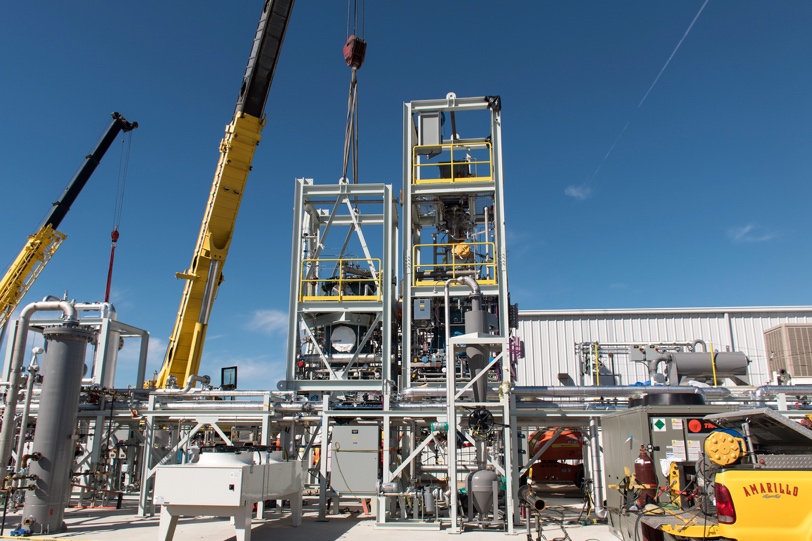
That progress attracted significant public-sector support. In 2012 and 2013, Sierra Energy received funding from both the U.S. Department of Defense and the California Energy Commission to construct its first commercial-scale demonstration facility at U.S. Army Garrison Fort Hunter Liggett in Monterey County. The project aligned closely with the military's goals of improving energy resilience while reducing waste sent to landfills, and it became one of the Department of Defense's flagship demonstrations of advanced waste-to-energy technology.
This image shows an industrial processing facility under construction, featuring a multi-level steel-framed structure with yellow safety railings and platforms. Two cranes—one yellow and one black—are positioned to lift and install equipment components, while various pressure vessels, piping systems, and gray tanks are visible throughout the site. A yellow vehicle marked "AMARILLO" is parked in the foreground on the right, and a white metal-clad building sits in the background under a clear blue sky.

Over the following decade, Sierra Energy steadily advanced FastOx from concept to proven demonstration. The Fort Hunter Liggett facility accumulated more than 1,250 documented operating hours while successfully converting municipal solid waste and waste wood into clean synthesis gas with approximately 80 percent cold-gas efficiency. The system also demonstrated one of FastOx® technologies’ defining advantages: converting inorganic materials into an inert, vitrified stone suitable for beneficial reuse rather than creating new waste streams requiring disposal. These results established confidence that the technology could serve as a flexible platform for producing electricity, hydrogen, renewable methanol, sustainable aviation fuel, and other valuable products from waste.

[IMAGE 5: This image shows an industrial gasification facility operated by Sierra Energy, featuring a tall multi-level steel structure with extensive piping, ladders, and platforms in the foreground, alongside a large metal building displaying the "SIERRA ENERGY" logo and name. A rainbow arcs across the partly cloudy blue sky in the background, and the foreground includes a network of insulated stainless steel pipes and industrial equipment, likely part of the company's FastOx gasification system for waste-to-energy conversion.

This appears to be a photograph of an operational facility rather than a chart, diagram, or data figure—no numerical data values, axes, percentages, or graphical labels are visible beyond the company branding.]

As technical milestones accumulated, so did industry recognition. Sierra Energy secured an expanding portfolio of patents and intellectual property, completed front-end engineering studies for larger commercial facilities, and attracted investment from organizations committed to accelerating climate and energy innovation, including Breakthrough Energy Ventures. Independent benchmarking has since identified FastOx as one of the most capital-efficient municipal solid waste gasification technologies evaluated, reinforcing the company's belief that commercial deployment can compete economically while delivering significant environmental benefits.

Today, Sierra Energy remains focused on commercialization. The company's next-generation (Gen 2) gasifier incorporates lessons learned from years of operation, simplifying the system while improving efficiency, lowering expected capital costs, and increasing operational flexibility. The Gen 2 unit has been fabricated and delivered to Fort Hunter Liggett, where installation and long-term operation are expected to establish a new commercial reference plant for customers and development partners.

At the same time, Sierra Energy has broadened its vision well beyond traditional waste management. Growing demand for reliable power from artificial intelligence and data centers has created new opportunities for around-the-clock renewable baseload generation. Current project development efforts span the United States and international markets, reflecting increasing interest from municipalities, industrial companies, developers, and infrastructure investors.
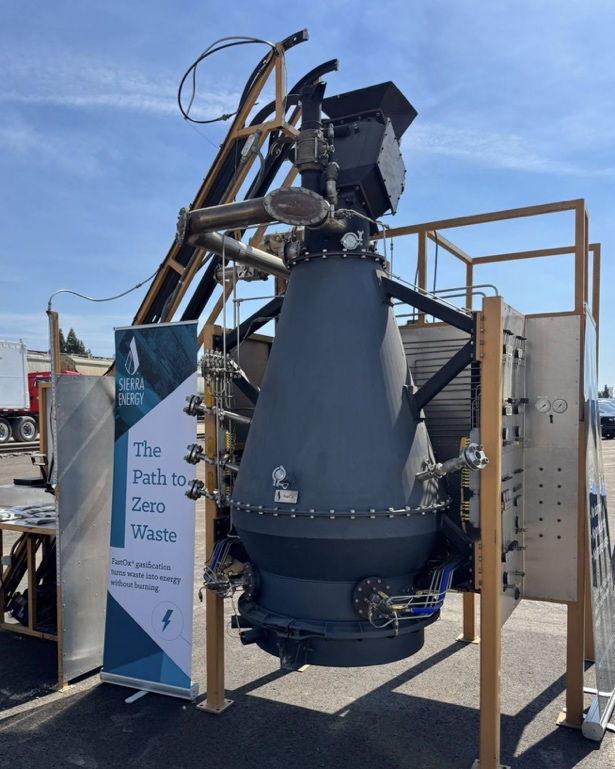
This image shows a Sierra Energy FastOx gasification unit—a large gray conical industrial reactor with numerous pipe connections, flanges, and instrumentation—displayed outdoors with a supporting yellow safety railing structure. A blue promotional banner beside it reads "SIERRA ENERGY: The Path to Zero Waste," describing that "FastOx gasification turns waste into energy without burning." The setup appears to be a demonstration or trade-show display, with a clear sky, parking lot, and vehicles visible in the background.

Looking ahead, Sierra Energy is pursuing a commercialization strategy that combines direct project development with regional licensing through its burgeoning TechPipe™ program. By enabling qualified regional developers to identify and advance projects under Sierra Energy's technical standards, the company aims to accelerate deployment while maintaining the quality and consistency of the FastOx platform.

More than two decades after its founding, Sierra Energy remains guided by the same principle that inspired its creation: that waste should not be buried but transformed into value. While the company continues its transition from successful demonstration to broad commercial deployment, its mission has remained remarkably consistent—to provide practical technologies that reduce landfill dependence, strengthen energy resilience, and help create a more circular, lower-carbon economy.

Got a question?

Ask our FastOx gasification assistant

Important Information Before You Continue

This site contains information about potential territorial distribution opportunities for FastOx® gasification technology. The materials are provided for business evaluation and discussion purposes only.

The site includes market-size information, equipment-value calculations, project-economics models, ROI estimates, sales estimates, profit estimates, compensation illustrations, environmental estimates, project pipeline information, technical descriptions, projections, forecasts, scenarios, and other forward-looking or assumption-based information. This information is based on Sierra Energy's current information, third-party sources, internal models, and assumptions that may change. It is not based on actual distributor results, completed distributor-originated projects, completed FastOx unit sales under this program, or actual territory performance.

Any projections, forecasts, models, estimates, scenarios, illustrations, or similar information on this site are illustrative and assumption-based. They are not guarantees, warranties, commitments, or promises of actual results. Actual results may differ materially from the information presented on this site. Sierra Energy does not represent that any project, sale, deployment, revenue, compensation, profit, return, market share, customer demand, territory value, environmental result, financing, permit, regulatory approval, or other outcome will occur or be achieved.

Any territorial distribution rights will be available only under a definitive written agreement signed by Sierra Energy and the approved distributor. Nothing on this site creates a franchise, dealership, agency, partnership, joint venture, technology license, operating right, authority to bind Sierra Energy, or right to sell, supply, operate, service, or sublicense FastOx gasification technology, FastOx units, or other Sierra Energy technology or equipment.

By continuing, you acknowledge that you have read and understand this information, including that financial, market, project, environmental, and other potential results presented on this site may be based on assumptions and modeling rather than actual distributor, project, or territory results, and that actual results may differ materially. You should rely on your own diligence and any definitive written agreement you sign with Sierra Energy, not on this site as a substitute for those materials.